Victorian Geology & Survey Solutions engaged by Aureka to acquire hi red LiDAR data.
High-Resolution Surveying Supporting Exploration at Aureka’s St Arnaud Silver–Gold Discovery
Recent exploration results released by Aureka Limited highlight renewed momentum in Victoria’s historic goldfields, with drilling at the Comstock Prospect identifying a previously unrecognised high-grade silver component associated with gold mineralisation.
While the drilling results themselves have attracted attention, an important part of modern exploration that often sits behind the scenes is the high-resolution spatial data used to guide geological interpretation, drilling logistics, and site planning.
As part of this work program, Aureka engaged Victorian Geology & Survey Solutions (VGSS) to undertake high-resolution aerial mapping of the project area, providing detailed terrain and surface datasets to support exploration activities across the site.
Modern Exploration Begins With Accurate Terrain Data
Before drilling begins, exploration teams must understand the landscape they are working in.
In structurally complex goldfields like those around St Arnaud, subtle terrain features can reveal:
historical workings and shafts
structural trends controlling mineralisation
historic reef alignments
access corridors for drill programs
environmental and heritage constraints
To support this work, VGSS completed high-resolution aerial data acquisition across the Comstock project area, capturing detailed terrain information that could be integrated directly into Aureka’s geological modelling and exploration planning.
The datasets allow geologists and engineers to work with centimetre-level surface models, improving accuracy for everything from drill collar positioning to structural interpretation.
A Historic Goldfield With New Potential
The St Arnaud district sits within the Stawell geological zone of the Lachlan Orogen, one of Australia’s most productive gold provinces.
Historical mining in the region produced approximately 400,000 ounces of gold at grades around 15 g/t, primarily from quartz reef systems developed along major structural faults.
However, much of this mining occurred in the late 1800s and early 1900s, long before modern exploration tools were available.
Today, companies like Aureka are applying modern exploration techniques to revisit these historic systems.
Recent drilling at the Comstock prospect has delivered several high-grade intersections including:
0.3 m @ 650 g/t silver and 1.91 g/t gold from 192 m
0.3 m @ 31.5 g/t gold from 127.5 m
These narrow but extremely high-grade intercepts are characteristic of Victorian quartz-reef style mineralisation, where gold and associated metals can occur in very high concentrations within structurally controlled veins.
Silver Adds a New Dimension to the System
One of the more interesting aspects of the latest drilling is the identification of a silver-rich component within the mineral system.
The mineralisation is associated with:
quartz vein systems
sulphide minerals including galena
structurally controlled fault zones
The presence of silver alongside gold suggests a more complex hydrothermal system than previously recognised at the project.
For exploration teams, identifying these structural controls is critical — and this is where high-resolution terrain and spatial datasets become particularly valuable.
Subtle changes in surface topography can often align with fault structures or historic reef trends, helping guide further drilling.
Integrating Aerial Survey Data Into Exploration Workflows
The high-resolution datasets captured by VGSS were designed to integrate directly into the project’s geological and engineering workflows.
These datasets typically support exploration teams by providing:
detailed digital terrain models
accurate surface mapping of historic workings
precise drill collar positioning
high-resolution orthographic imagery
spatial control for geological modelling
For structurally complex gold systems like those found across the Victorian goldfields, this level of spatial detail can significantly improve exploration targeting.
From Exploration Data to Development Planning
The Comstock project currently hosts a maiden JORC resource of approximately 56,500 ounces of gold, with additional exploration potential identified across the broader project area.
Importantly, the project sits within trucking distance of several operating gold processing facilities in Victoria, which could provide a pathway for future development if exploration continues to deliver positive results.
As exploration programs expand, high-resolution spatial datasets often become a foundation layer for:
resource modelling
mine design studies
environmental assessments
infrastructure planning
For this reason, detailed terrain capture early in a project can provide long-term value throughout the life of an exploration program.
Supporting Exploration Across Victoria’s Goldfields
Victoria’s goldfields remain one of the most prospective mineral provinces in Australia, with ongoing exploration continuing to uncover new opportunities within historic districts.
Modern exploration now combines advanced drilling, geochemical analysis, structural geology, and high-resolution spatial data to better understand these systems.
Projects like Aureka’s Comstock prospect demonstrate how combining historic knowledge with modern technology can reveal new insights within some of Australia’s oldest goldfields.
As exploration continues at St Arnaud, the integration of detailed aerial surveying alongside drilling and geological interpretation will remain an important part of building a clearer picture of the mineral system.
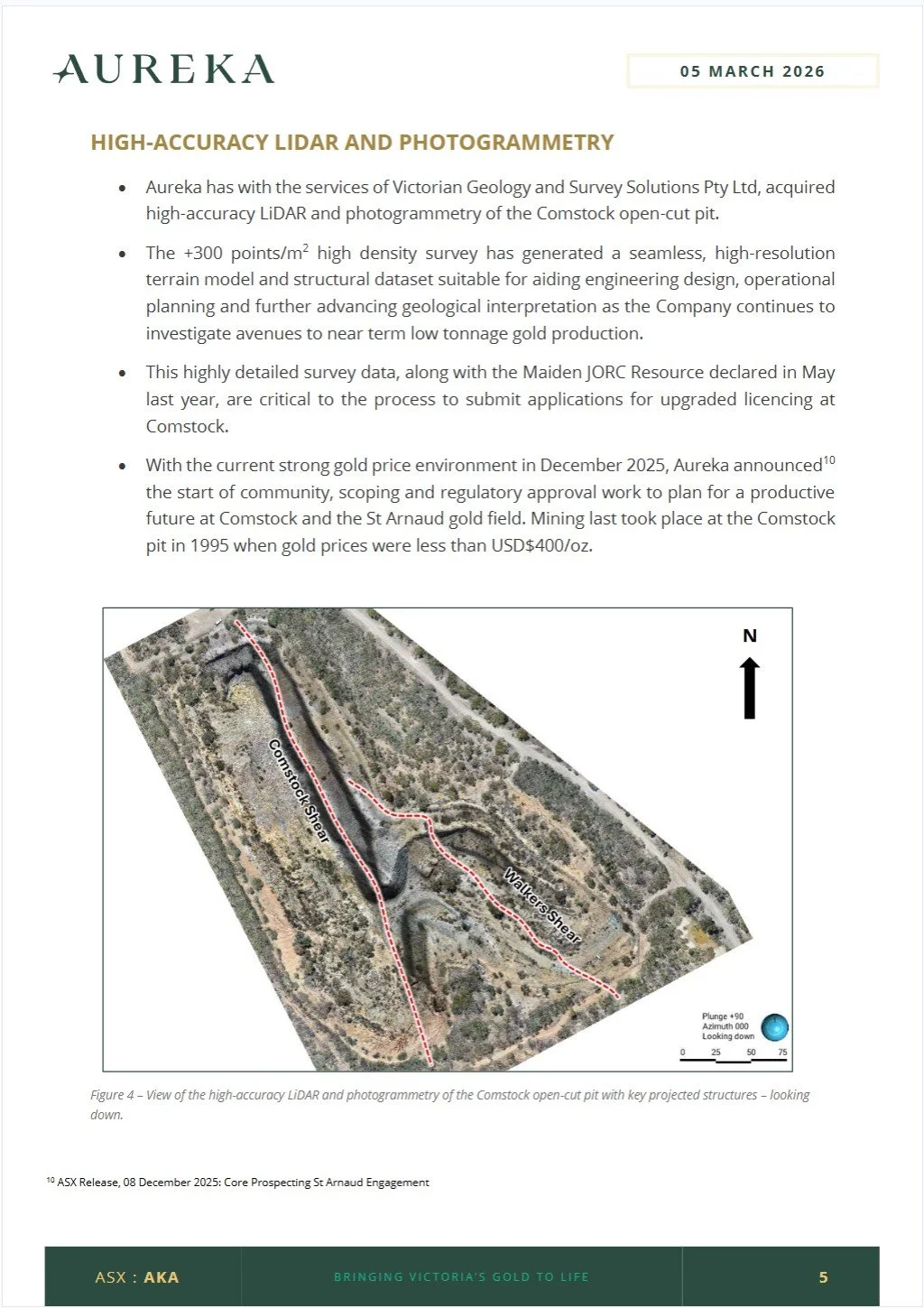
“Excerpt from Aureka Limited ASX announcement referencing aerial survey work undertaken by VGSS.”